
Medications That Should Not Be Crushed: What Every Nurse Should Know

Marhaba! 🇸🇦
“Nurse, this tablet is too big for me to swallow. Can you crush it for me?”
If you have done a med round on any ward in Saudi, you have heard this. Maybe from an elderly patient after a stroke. Maybe from someone who just hates big tablets. And the kind answer feels like “Sure, give me a minute.”
But not every tablet is safe to crush. Some are built to release the drug slowly over a whole day. Some have a coating that has a real job to do. Crush them and you break the design.
This guide covers what the letters after a drug name mean, how each type works, and what to do at the bedside when a patient asks.
Why crushing can cause harm
When you crush a special release tablet, one of three things can happen:
- Dose dumping. The dose meant to last 12 or 24 hours hits the body all at once. Then the level drops and the patient has no cover later in the day.
- The drug stops working. Stomach acid destroys a drug that was meant to be protected.
- The stomach gets hurt. A drug that should open in the small intestine irritates the stomach lining instead.
With opioids like MST Continus or OxyContin, dose dumping can cause a fatal overdose. This is not a small mistake.
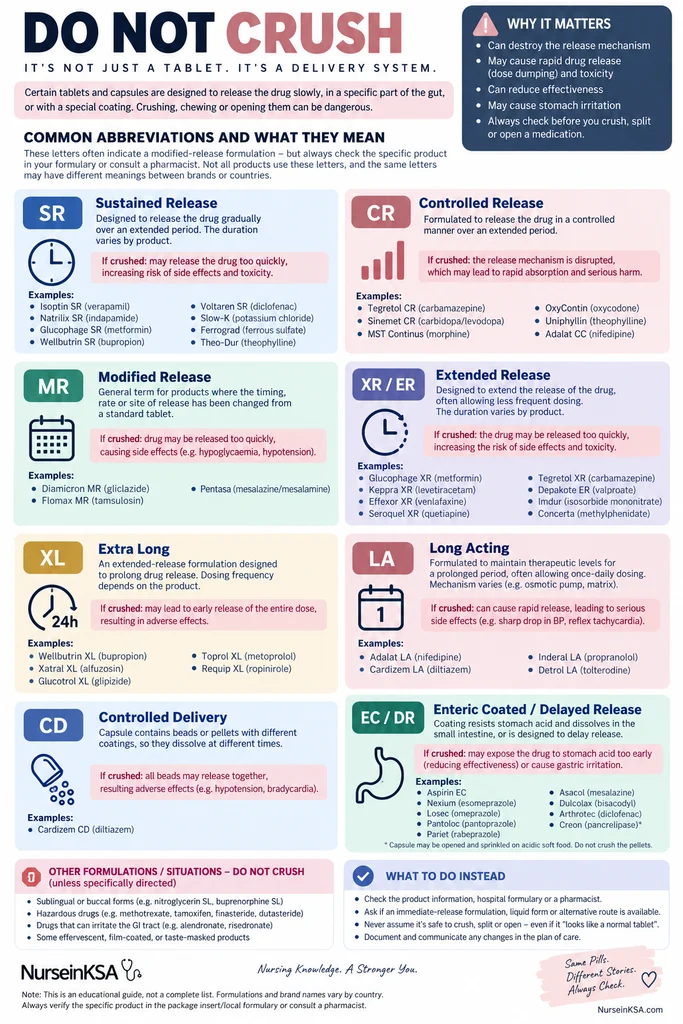
*Some capsules, like Nexium, Losec, and Creon, can be opened. The pellets inside must not be crushed or chewed.
How they work, in simple words
- SR, CR, XR, XL: The drug sits inside a wax or polymer base. It leaks out slowly as the tablet moves through the gut.
- MR: This is the umbrella term. The timing, speed, or place of release has been changed.
- Adalat LA: This one works like a tiny pump. Water enters the tablet and pushes the drug out through a small laser drilled hole. Crush it and the pump is gone.
- Cardizem CD: The capsule holds tiny beads with different coatings. Each group dissolves at a different time, like a relay race.
- EC and DR: The coating stays shut in stomach acid and opens in the small intestine. It protects the drug from the acid, or the stomach from the drug.
Watch for brand codes too. These also mean slow release, even without SR or XR on the box: ZOK (Betaloc ZOK), OCAS (Omnic OCAS), Chrono (Depakine Chrono), Retard (Tramal Retard), HBS (Madopar HBS), plus Continus, Durules, and OROS.
Other tablets you should not crush
- Sublingual and buccal tablets. Nitroglycerin SL and buprenorphine SL are made to dissolve under the tongue or in the cheek.
- Hazardous drugs. Methotrexate, tamoxifen, finasteride, dutasteride, and mycophenolate. Crushing makes dust that you and your coworkers breathe in or touch. Finasteride and dutasteride are a special risk for pregnant staff.
- Drugs that hurt the food pipe. Alendronate and risedronate can irritate the esophagus. They should be swallowed whole with a full glass of water, with the patient sitting upright after.
What about plain tablets?
Most plain, immediate release tablets can be crushed. But not all of them. Some taste awful, some break down once crushed, and some are hazardous.
The old “do not crush” lists were also stricter than needed in places. A 2021 study found that many immediate release items on the well known list could be crushed under the right conditions. So the list is a guide. Your pharmacist has the final word.
When the patient says, “It’s too big”
This is where good nursing matters. Here is what to do:
- Ask what the real problem is. Is it the size of the tablet, or trouble swallowing in general? These need different fixes.
- Check the label and your ward’s do not crush list. Look for any letters or brand codes after the name.
- Call pharmacy. Ask about a liquid form, a dispersible tablet, an immediate release form with a new schedule, or another route.
- Never crush slow release or enteric coated tablets just to make them easier to take.
- If a drug is allowed to be crushed, crush each one on its own. Do not mix them together.
- If the patient cannot swallow safely, flag it for a swallow assessment. Who does this depends on your unit policy.
- Document the change in the care plan so the next shift knows.
A small tip: if a dose form changes, check the timing too. A once daily XL tablet swapped for an immediate release form may need two or three doses a day.
One rule to remember
If there are letters after the drug name, stop and check before you crush.
Same pills. Different stories. Always check.
With heartfelt thanks,
NurseinKSA 🇸🇦
Enjoyed this story?
Subscribe to get the latest updates on my nursing journey in KSA directly to your inbox.
Read Next
View all posts
Saudi Prometric Exam for Nurses 2025: Complete Step-by-Step Guide (Eligibility, Fees & Tips)
Marhaba! 🇸🇦 Embarking on a nursing career in Saudi Arabia is a professionally rewarding decision, and the first critical step on this journey is the Saudi Prometric exam. Rather than viewing it as a barrier, think of it as the official gateway to a wealth of opportunities in the Kingdom’s rapidly expanding healthcare sector. 1. […]

From Textbook to Bedside: How to Confidently Administer Medications
Marhaba! 🇸🇦 You graduated from nursing school knowing the rules. You could recite the Five Rights, master the math, and ace any exam on medication administration. But the first time you stand at the bedside with a tray of life-saving and potentially life-threatening drugs for your own patient, a quiet but persistent question arises: “What […]

How to Become a Nurse in Saudi Arabia: Step-by-Step Guide for Foreign Nurses (2025)
Marhaba! 🇸🇦 If you’re a nurse dreaming of working in Saudi Arabia, you’re definitely not alone. It’s a path many of us take seeking professional growth and a more secure future. I was one of those who took this exciting step, and my own journeytook a total of eight months from the day I first […]